AI engineering tip of the week: Pass dataclasses, Pydantic models, and complex types between tasks with Serialization
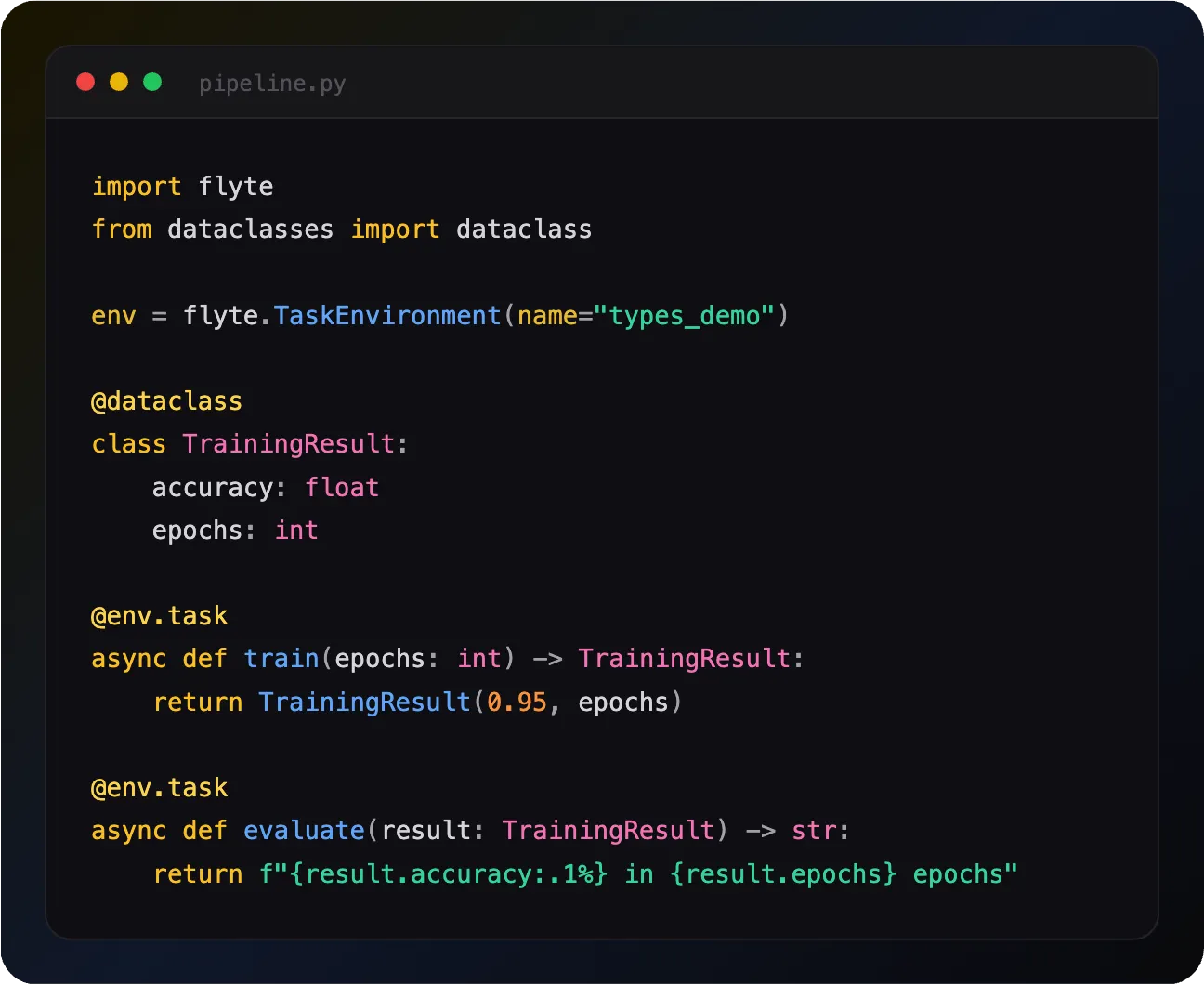
In most AI orchestrators, passing data between steps means converting everything to JSON strings or saving to files manually. Flyte handles serialization for you. Return a dataclass from one task, accept it in the next. Flyte serializes it automatically using MessagePack under the hood, and the types show up in the UI.
Dataclasses just work
No JSON serialization code. No schema definitions. Just Python dataclasses flowing between tasks.
Pydantic models work too
If you prefer Pydantic for validation, those work the same way:
You get Pydantic's validation on the way in, and Flyte handles the serialization between containers.
Nest complex types freely
Dataclasses can contain lists, dicts, other dataclasses, enums, datetimes, and more:
Lists of dataclasses, enums inside dataclasses, nested dicts with typed values. It all serializes correctly.
Union types for flexible inputs
Need a task that accepts different types? Use Python's union syntax:
Flyte discriminates the union type at runtime and deserializes the correct variant.
TypedDict and NamedTuple
Python's structural types also work:
Include files in your data models
Dataclasses and Pydantic models can contain `flyte.io.File` and `flyte.io.Dir` for mixing metadata with large artifacts:
The metadata (name, version, accuracy) is serialized inline. The weights file is stored in the object store and referenced by URI. Best of both worlds.
What types are supported
- Primitives: str, int, float, bool
- Date/time: datetime, timedelta
- Collections: list, dict, tuple (typed)
- Structures: dataclass, BaseModel, TypedDict, NamedTuple
- Enums: str enums, int enums
- Unions: `X | Y` or `Union[X, Y]`
- Optional: `Optional[X]`
- Files: `flyte.io.File`, `flyte.io.Dir`
- Custom types: Register your own TypeTransformer for anything else
How do you pass agent state between tasks?
Return a Pydantic model or dataclass from the task and accept it in the next one. Flyte serializes it for you, so agent state moves between containers without you writing JSON encoders or parsing strings back into objects.
This could matter more for agents than for classic pipelines. An agent step produces messy, nested state: a message history, a list of tool calls, token counts, a confidence score. If your orchestrator only passes strings, every hop becomes `json.dumps` on the way out and a fragile `dict["key"]["maybe_here"]` on the way in. One schema change and you are debugging a `KeyError` in a container you cannot see.
Because LLM structured output is already a Pydantic model, you hand Flyte the same model you gave the LLM:
What you get from typed serialization in an agent loop:
- Validation at every hop, so a malformed LLM response fails at the task boundary instead of three steps later
- Readable inputs and outputs in the UI, so you can see the exact state an agent step received when it went off the rails
- Safe schema evolution, since adding a field to the model updates every task that passes it
- Caching and retries that work on real objects, not on strings you have to re-parse
Full type system docs: https://www.union.ai/docs/v2/flyte/user-guide/tasks/task-programming/dataclasses-and-structures/
See what's happening in the Flyte Community:
Latest from the blog
- Flyte 2 Is Generally Available: The Durable, Open-Source AI Runtime - Read on Union.ai
- Why Untrusted Kernel Evaluation Needs Process Isolation (and How We Built It) - Read on Union
- A Memory Store Built on Flyte and Cognee - Read on Union.ai
- Building Grounded Agents on Fresh Web Data - Read on Union.ai
- From DNA to 3D Fold: Compare a Gene Across Six Species with Carbon and ESMFold - Read on Union.ai
- Run Models, Agents and Apps on Infrastructure You Own - Read on union.ai
- Agents That Survive Production: Rebuilding 21 Design Patterns on Flyte - Read on union.ai
- Introducing Queues and Cluster Controls: Durable Workloads Under Contention - Read on union.ai
Recent talks & recordings
- When the Pipeline Breaks: Building ML Infrastructure for Biotech R&D | Session 1 - Watch on YouTube
- Building Code Mode Agents - Watch on YouTube
- LLM fine-tuning with GRPO - Watch on YouTube
- LLM fine-tuning with LoRA & QLoRA - Watch on YouTube
Upcoming events
- Aug 18th: Flyte 2: The Durable Runtime Built for AI - RSVP on Luma
- Aug 20th: Seattle RAG & Agent Context with Vector Stores | AI Hacknight - RSVP on Luma
Releases & updates
- Flyte 2 Is Generally Available: The Durable, Open-Source AI Runtime - Read on Union.ai
<div class="button-group is-center"><a class="button" target="_blank" rel="noopener noreferrer" href="https://www.union.ai/docs/v2/flyte/user-guide/run-modes/running-devbox/">Download Devbox</a></div>
From the community
- Open-Source Music Generation: Text-to-Music & Lyrics-to-Song - RSVP on Luma
- AI Book Club: Build a Reasoning Model (From Scratch) - RSVP on Luma
That's all for this week! - Sage Elliott