Union.ai vs. Airflow

Still orchestrating AI/ML workloads with tools built for ETL?

Union.ai, the managed Flyte platform, is the production runtime for the AI era. Orchestrate compute, models, and data on your own secure cloud. No DAGs needed.

Try the devbox

A free, local sandbox to explore the Union.ai platform.

Chat with an engineer

Old eras of orchestration don’t work for AI

Using a data orchestrator instead of an AI runtime is like using a paper map instead of GPS.

Orchestration has evolved through 3 distinct eras:

  • Data Era: move data from A to B
  • ML Era: run workloads on different compute resources
  • AI & Agentic Era: dynamically determine workflow paths at runtime

AI is non-deterministic, so it needs to branch, handle errors, and provision resources dynamically at runtime. 

Static DAGs aren’t built for this reality.

Airflow was built for data, not AI

Airflow was designed to move structured data between systems on a schedule. That worked when every task shared one environment and one compute profile. But AI workloads broke that assumption:

  • One-size-fits-all compute. Airflow runs tasks in a monolithic environment. When your preprocessing needs CPUs and your training needs GPUs, you're either overprovisioning everything or bolting on workarounds.
  • No native data handoff. Passing data between tasks means writing custom serialization, storage logic, and glue code — a primary source of bugs and version drift.
  • Static DAGs, brittle pipelines. The execution graph is defined before runtime. When an LLM call needs to branch, retry with different parameters, or spin up new tasks based on intermediate results, Airflow has no answer.
  • Lineage is an afterthought. Tracking which data produced which model requires external tooling. At scale, this becomes a compliance and debugging nightmare.

If you’re running simple data workloads, these compromises can be totally fine. But if you’re orchestrating AI or agentic projects, you’ll need an AI runtime.
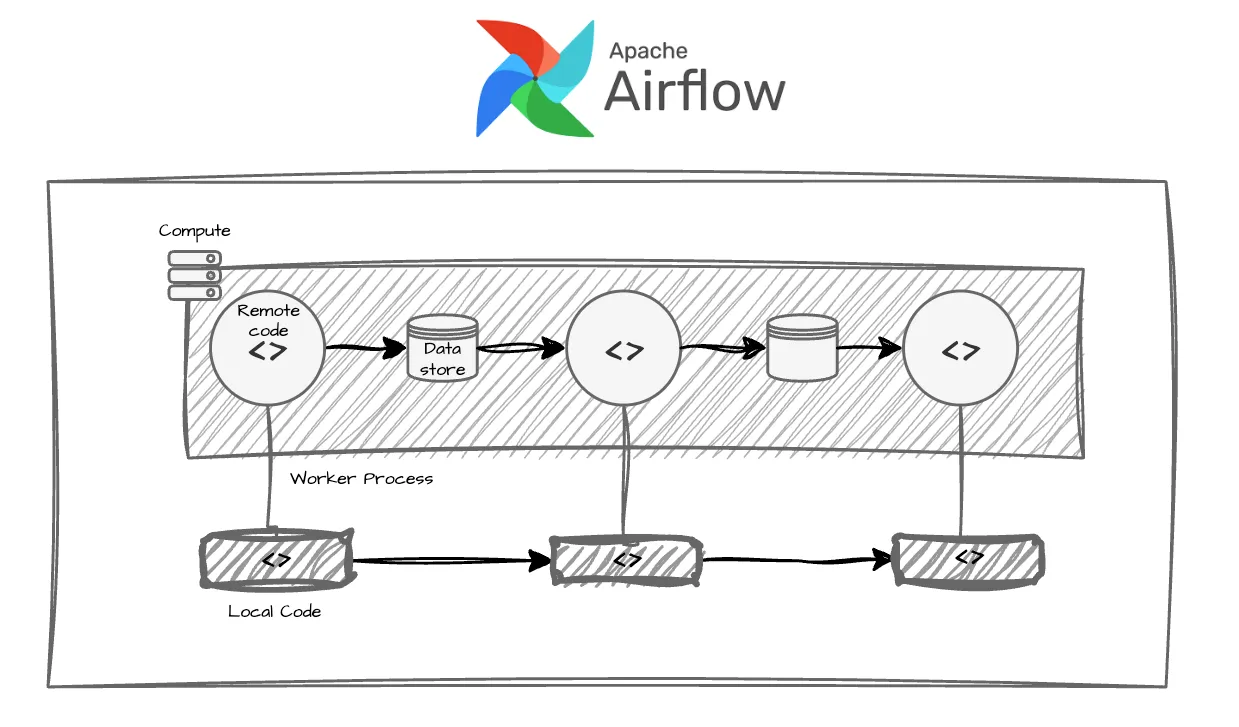
Per-task compute profiles
Limited
Tasks run in a shared worker environment; separating CPU preprocessing from GPU training requires bolted-on workarounds like KubernetesPodOperator, adding config overhead and complexity
Each task declares its own compute requirements; GPU type, memory, and CPU set per task
Same per-task compute plus task-level routing across clusters; one workflow can preprocess on CPU spot, train on H100s, and validate on cheaper GPUs without manual coordination
Native typed data passing
XCom for small values; large data requires custom serialization, S3 paths, and glue code between tasks — a primary source of bugs and version drift
Typed inputs and outputs passed natively between tasks; no manual serialization or path management
Same typed data model plus artifact registry; outputs are versioned, browsable, and lineage-linked across runs
Dynamic workflows at runtime
DAG structure is fixed at parse time; branching is limited to pre-defined paths; workflows cannot adapt based on what an LLM call or intermediate result returns
Pure Python control flow; tasks can spawn new tasks, branch, and adapt based on intermediate results at runtime
Same dynamic model plus runtime resource overrides; tasks can request different hardware mid-workflow based on what intermediate results require
Data lineage
External only requires OpenLineage or custom tooling; not built into the platform; at scale this becomes a compliance and debugging liability
Partial
Typed inputs and outputs are tracked per task, lineage is limited to execution metadata and user conventions
Full cross-run provenance graph queryable through UI and SDK; when a dataset is bad, immediately identify every model and artifact downstream
Python-native authoring
Partial
DAGs are written in Python but as static declarative definitions; the operator pattern feels like config, not code; loops and conditionals define structure, not execution
Pure Python with decorators; workflows are real Python functions with loops, conditionals, and normal async control flow that execute at runtime
Same Python model; no rewriting needed to move from Flyte OSS to Union.ai
Self-healing and retries
Partial
Task-level retries with configurable backoff, but no adaptive failure recovery or typed exception handling
Configurable retry policies with backoff; failed tasks restart automatically
Same retry model plus typed exception handling; catch specific failure modes and adapt rather than retrying blindly
Local development
Partial DAGs can be tested locally but environment parity with production requires manual setup; Kubernetes executor behavior does not replicate locally
Run any workflow locally with pyflyte run; full environment parity before pushing to production
Same local execution plus Union devbox for iteration against production-identical infrastructure
Cold start latency
30s+
Celery and Kubernetes executor cold starts typically 30s or more; local executor is faster but not production-grade
~30s
Standard Kubernetes pod scheduling and container startup on every task
<1s
Reusable containers keep the process warm; sub-100ms for repeated invocations, the difference between a batch job and an interactive loop
Task fanout
Limited dynamic task mapping helps but large fan-out hits scheduler bottlenecks at high cardinality
~10K tasks
Bounded by Kubernetes control-plane scheduling throughput
250K+ tasks
Purpose-built execution substrate bypasses the K8s pod-scheduler bottleneck that caps Flyte OSS at high cardinality
Deploys in your cloud
DIY ops
Self-managed or cloud-specific MWAA on AWS, Cloud Composer on GCP; managed options exist but are locked to one cloud, or your team owns all ops
DIY ops
Self-managed any cloud, but your team owns all installation, ops, upgrades, and infrastructure
Union.ai manages the platform so your team focuses on workflows, not infrastructure maintenance

Union.ai is AI-native orchestration

Union.ai, the enterprise Flyte platform, is expressly designed for AI engineers. Teams can build workflows that are:

  • Self-healing, so pipelines that fail autonomously recover and continue
  • Dynamic, so your AI systems and agents can make decisions on the fly at runtime
  • Authored in pure Python, so you can easily go from local dev to production in your cloud
  • Compute-aware, operating in your cloud and auto-scaling to optimize usage
  • Scalable and efficient, handling large task fanout and parallelism with ease
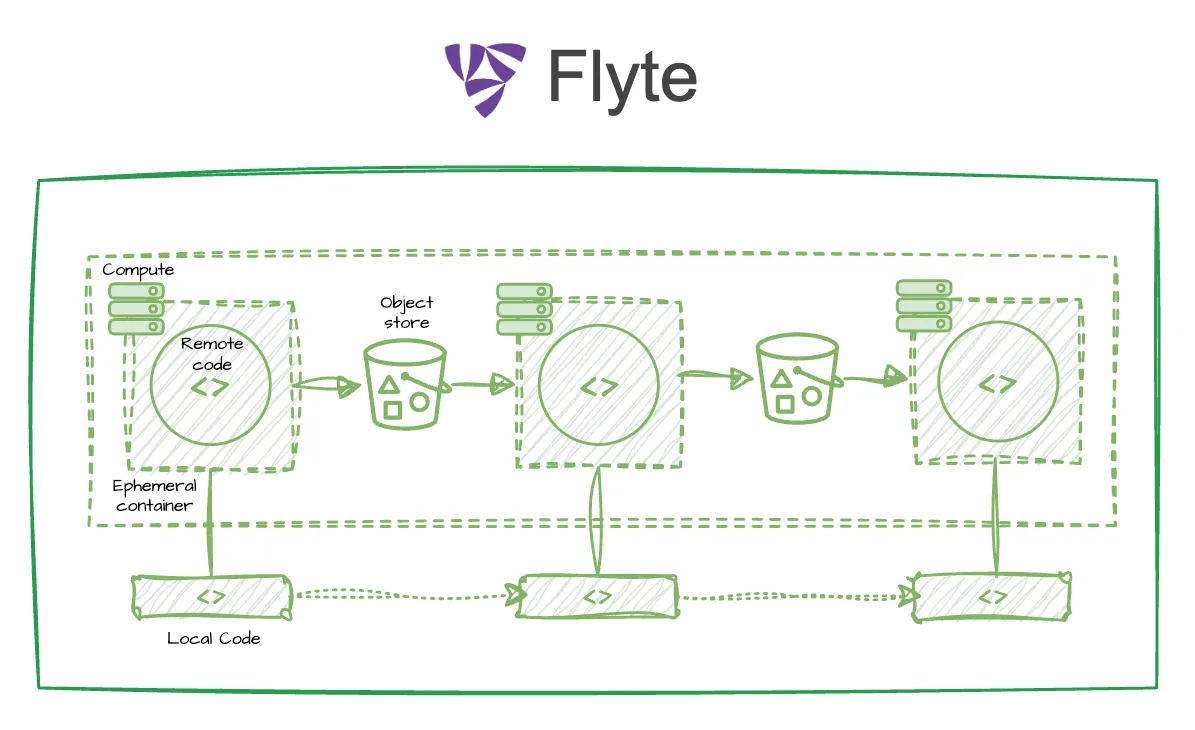
Union.ai is built for production

The platform deploys to your secure cloud

  • Enhanced scale and performance, with significantly improved actions/run, concurrency, and task startup time
  • End-to-end AI lifecycle support, including orchestration, training and fine-tuning, and inference
  • Developer-loved UI, for faster, easier development cycles
  • Observability, including for data lineage, resource usage, failure logs, etc.
  • Portability to open-source, for teams looking to avoid lock-in

Teams report that Union.ai accelerates them from prototype to production, cutting iteration cycle time in half

The Union.ai team offers high-touch support to ensure users are successful.
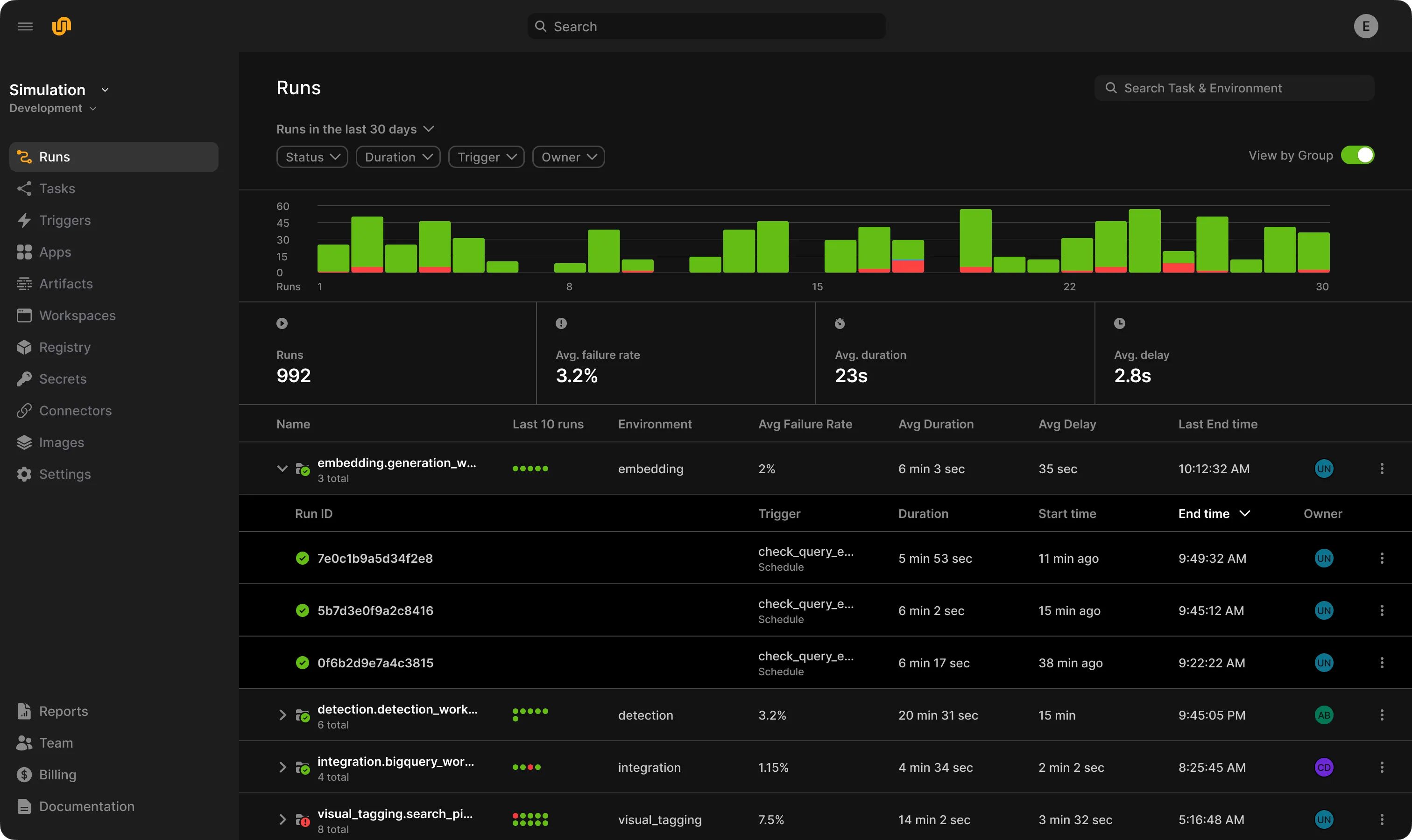
Flyte 2 OSS: Open-source AI runtime

Flyte 2 OSS is the most powerful open-source AI runtime, bringing Flyte’s core data model, scalability, and reliability to DIY teams. While it lacks some enterprise capabilities of Union.ai, it remains the most capable open-source AI runtime available. It’s trusted by teams worldwide with 80M+ downloads and growing.
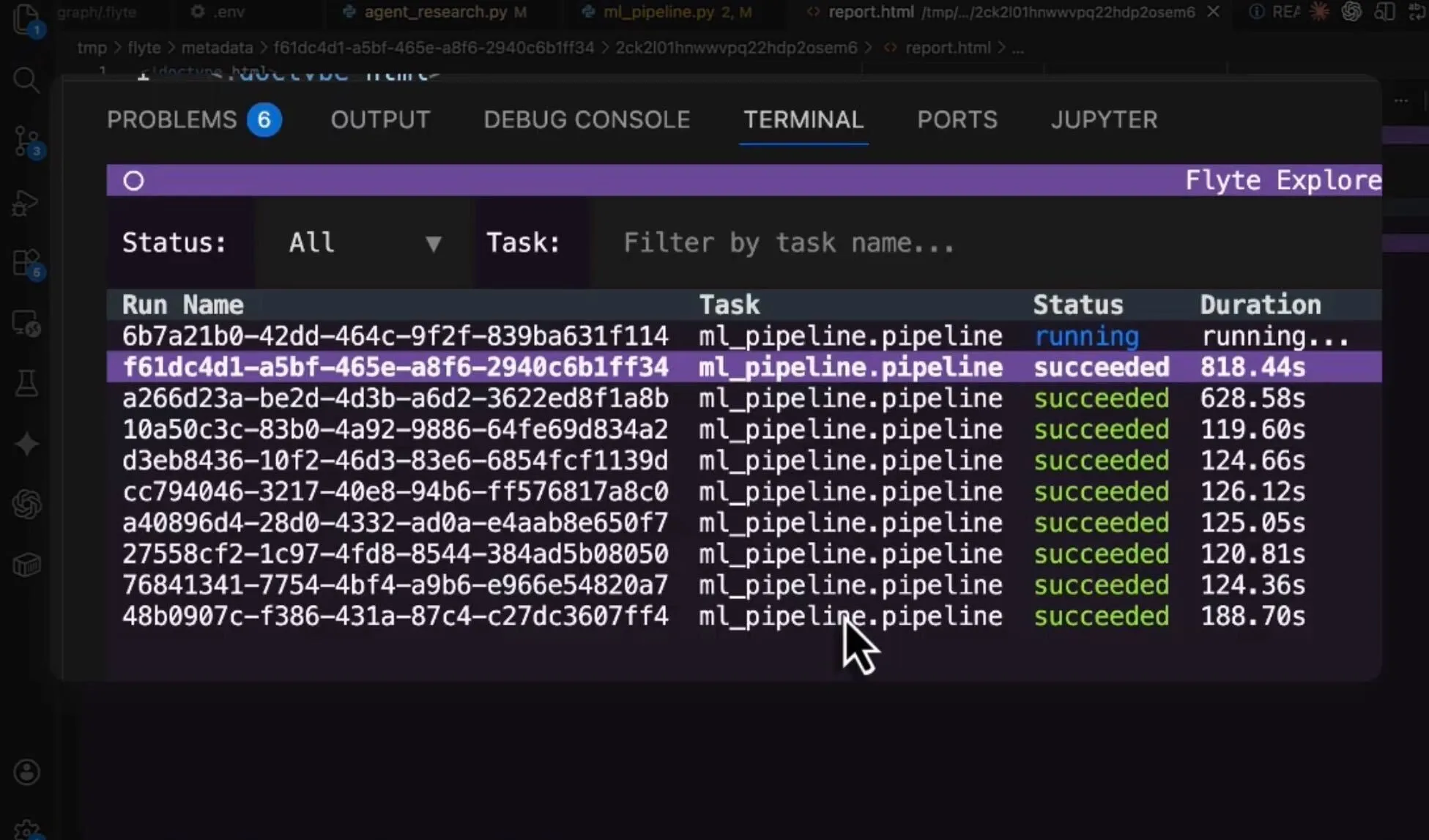
Trusted by 4,000+ companies

Accelerate engineers with tools to make their lives easier.

Let’s chat

What’s a quick chat compared to the hours a week you could save on maintaining infrastructure?